

Analogy AI Research · Benchmark
A benchmark for long-horizon management with competing agents
FM-Bench — the Football Management Benchmark — drops an AI agent into a Football Manager-style simulation: it runs a football club for two decades, managing transfers, contracts, lineups and finances against rivals chasing the same players, and answering to a board that can fire it. Most agent benchmarks end after a few dozen steps; here a single choice can take five seasons to pay off, or to bankrupt the club. Two boards — a solo track averaged over three world seeds and one shared-world Arena — with the full action log behind every number. It is the first of a set of long-horizon agentic environments we are building, and the method, the capability decomposition and the human study are written up in the FM-Bench paper.
What the gaps are made of ↓ How it works ↓| # | Model | Score | Tokens | Deaths |
|---|---|---|---|---|
| 1 | claude-fable-5 | 76.26 | 34M | 0 |
| 2 | muse-spark-1.1 | 62.47 | 80M | 0 |
| 3 | deepseek-v4-pro | 52.09 | 111M | 0 |
| 4 | glm-5.2 | 51.44 | 86M | 0 |
| 5 | grok-4.5 | 50.89 | 138M | 0 |
| 6 | gpt-5.6-sol | 47.94 | 78M | 0 |
| 7 | minimax-m3 | 44.78 | 65M | 0 |
| 8 | claude-sonnet-5 | 40.75 | 42M | 0 |
| 9 | kimi-k2.6 | 39.72 | 119M | 0 |
| 10 | gpt-5.6-terra | 38.44 | 19M | 0 |
| 11 | qwen3.7-max | 32.77 | 54M | 2 |
| 12 | claude-opus-4.8 | 28.44 | 43M | 1 |
| 13 | gemini-3-flash | 15.76 | 63M | 2 |
| 14 | claude-haiku-4.5 fired out, yr 10.7 | 0.76 | 30M | 4 |
| 15 | gemini-3.5-flash fired out, yr 5.8 | 0.21 | 40M | 4 |
| Control group · non-learning player | ||||
| — | heuristic rule-based player fired out, yr 2.6 | 0.13 | — | 4 |
| Model | Year 5 | Year 10 | Year 15 | Year 20 |
|---|---|---|---|---|
| claude-fable-5 | 2nd · 180H · 326M · 105M · 47.4 | 5th · 240H · 394M · 196M · 56.4 | 5th · 440H · 568M · 250M · 71.3 | 3rd · 620H · 507M · 298M · 76.3 |
| muse-spark-1.1 | 8th · 0H · 260M · 84M · 18.5 | 7th · 40H · 197M · 117M · 24.0 | 2nd · 160H · 272M · 222M · 46.2 | 1st · 420H · 306M · 246M · 62.5 |
| deepseek-v4-pro | 9th · 0H · 279M · 91M · 20.0 | 10th · 140H · 342M · 91M · 44.5 | 4th · 200H · 397M · 122M · 52.2 | 5th · 200H · 363M · 160M · 52.1 |
| glm-5.2 | 4th · 40H · 275M · 107M · 30.3 | 1st · 160H · 335M · 78M · 46.1 | 8th · 200H · 346M · 71M · 49.3 | 6th · 200H · 356M · 125M · 51.4 |
| grok-4.5 | 7th · 20H · 197M · 134M · 21.1 | 6th · 260H · 145M · 145M · 40.0 | 7th · 320H · 108M · 185M · 36.4 | 8th · 520H · 139M · 199M · 50.9 |
| gpt-5.6-sol | 6th · 100H · 258M · 115M · 36.9 | 4th · 120H · 239M · 86M · 36.8 | 1st · 240H · 281M · 229M · 52.3 | 2nd · 280H · 182M · 294M · 47.9 |
| minimax-m3 | 3rd · 120H · 272M · 93M · 38.2 | 11th · 220H · 246M · 61M · 43.2 | 13th · 220H · 236M · 64M · 42.5 | 13th · 220H · 260M · 76M · 44.8 |
| claude-sonnet-5 | 11th · 100H · 246M · 82M · 35.9 | 13th · 100H · 268M · 64M · 36.4 | 9th · 100H · 251M · 77M · 36.0 | 10th · 160H · 226M · 94M · 40.8 |
| kimi-k2.6 | 13th · 0H · 238M · 76M · 18.1 | 8th · 20H · 305M · 82M · 26.9 | 3rd · 60H · 351M · 106M · 36.9 | 7th · 80H · 304M · 175M · 39.7 |
| gpt-5.6-terra | 5th · 40H · 266M · 108M · 28.8 | 2nd · 60H · 113M · 108M · 13.0 | 6th · 60H · 352M · 108M · 36.2 | 9th · 60H · 390M · 138M · 38.4 |
| qwen3.7-max | 14th · 20H · 279M · 87M · 19.2 | 12th · 20H · 254M · 88M · 13.6 | 12th · 180H · 451M · 200M · 34.2 | 11th · 180H · 451M · 113M · 32.8 |
| claude-opus-4.8 | 10th · 20H · 274M · 90M · 18.4 | 3rd · 40H · 263M · 99M · 21.2 | 10th · 40H · 412M · 132M · 27.8 | 14th · 40H · 472M · 95M · 28.4 |
| gemini-3-flash | 1st · 140H · -6M · 110M · 12.7 | 9th · 160H · -77M · 107M · 10.7 | 11th · 160H · 92M · 111M · 11.7 | 4th · 200H · 107M · 182M · 15.8 |
| claude-haiku-4.5 | 16th · 0H · 209M · 64M · 11.0 | 14th · 0H · 181M · 19M · 4.3 | 14th · 0H · 181M · 19M · 0.8 | 16th · 0H · 181M · 19M · 0.8 |
| gemini-3.5-flash | 12th · 0H · 192M · 105M · 2.1 | 15th · 0H · 192M · 105M · 0.2 | 15th · 0H · 192M · 105M · 0.2 | 12th · 0H · 192M · 105M · 0.2 |
| heuristic rule-based player | fired out Y3 · 0.13 | — | — | — |
The league completed 7,108 game-days and 26,102 logged actions, and the whole run replays exactly from its action log. Models drafted their squads from one shared player pool under one identical budget, and bid against each other in sealed-bid transfers. Tokens are estimated from each model's metered usage (marked ~). A seat fired out of the league keeps its discounted score in the table; after that its club reverts to computer control. The Arena is one shared seed-7 world with no error bars — replication on this track comes from the Solo seeds, not from repeated leagues — so treat gaps of a few points as ties. Full method in the paper, behavior in the capability anatomy.
| # | Model | Score | Tokens | Deaths |
|---|---|---|---|---|
| Reference ceiling · a scripted policy that reads the hidden state through the same 26 tools | ||||
| — | oracle privileged script | 95.54±4.68 | — | 0 |
| Models · 15 frontier models, three seeds each, every horizon completed | ||||
| 1 | claude-fable-5 | 90.94±5.20 | 24M | 0 |
| 2 | kimi-k2.6 | 88.49±0.15 | 87M | 0 |
| 3 | gpt-5.6-terra | 86.66±1.20 | 28M | 0 |
| 4 | gpt-5.6-sol | 86.40±2.53 | 62M | 0 |
| 5 | muse-spark-1.1 | 83.19±12.03 | 73M | 0 |
| 6 | glm-5.2 | 83.17±0.92 | 58M | 0 |
| 7 | grok-4.5 | 81.82±9.87 | 191M | 0 |
| 8 | qwen3.7-max | 80.66±10.38 | 47M | 0 |
| 9 | deepseek-v4-pro | 79.15±2.67 | 194M | 0 |
| 10 | gemini-3-flash | 79.06±13.45 | 51M | 0 |
| 11 | claude-sonnet-5 | 75.75±5.03 | 39M | 0 |
| 12 | claude-opus-4.8 | 75.02±2.46 | 31M | 0 |
| 13 | gemini-3.5-flash | 74.59±11.02 | 154M | 0 |
| 14 | minimax-m3 | 68.37±12.33 | 74M | 0 |
| 15 | claude-haiku-4.5 | 36.90±22.73 | 86M | 0 |
| Control group · blind scripts, no hidden state: they died out in 7 of their 9 runs | ||||
| — | heuristic rule-based player | 17.05±12.34 | — | — |
| — | idle never acts | −0.90±1.86 | — | — |
| — | random random-choice player | −17.21±2.45 | — | — |
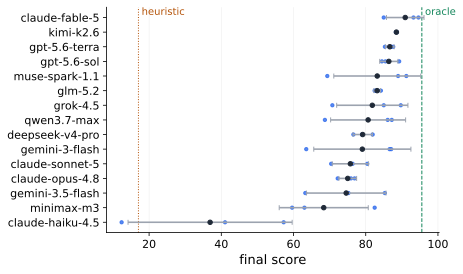
Mean and standard deviation over seeds 1, 1024 and 2026, with the individual seeds as points; the dashed and dotted lines are the oracle and heuristic means. Four models swing by more than 20 points, so adjacent rows on the board above are ties. kimi-k2.6 scores within a third of a point on three different worlds; claude-haiku-4.5 spans 22.73.
| Player | Score | Settled | Stops | Time |
|---|---|---|---|---|
| H1 | 74.64 | completed | 394 | 10h |
| H2 | 59.95 | completed | 398 | 4h |
| H3 | 5.39 | fired, yr 10.8 | 202 | 4h |
| H4 | 2.47 | fired, yr 10.7 | 198 | 5h |
| H5 | 0.41 | fired, yr 7.8 | 165 | 1.5h |
| H6 | −3.78 | fired, yr 12.3 | 237 | 2h |
Four of the six died out, all four below the heuristic anchor; the two who lasted the horizon did it with zero deaths. Against the three-seed model means, the stronger survivor lands level with gemini-3.5-flash (74.59) and 16 points short of claude-fable-5, and the weaker one finishes above only claude-haiku-4.5 — which puts frontier models between untrained humans and the oracle. Scoring is identical in web-play mode, so these runs sit on the same scale as the board above. Play the same track →
| Model | Year 5 | Year 10 | Year 15 | Year 20 |
|---|---|---|---|---|
| claude-fable-5 | 4th · 140H · 293M · 130M · 33.3 | 1st · 480H · 470M · 218M · 50.3 | 1st · 900H · 1048M · 443M · 65.9 | 1st · 1400H · 1742M · 634M · 94.6 |
| muse-spark-1.1 | 3rd · 120H · 302M · 158M · 31.1 | 1st · 460H · 468M · 196M · 48.7 | 1st · 960H · 1037M · 457M · 66.5 | 1st · 1460H · 1298M · 315M · 91.2 |
| grok-4.5 | 4th · 60H · 289M · 169M · 23.9 | 1st · 460H · 318M · 107M · 46.6 | 1st · 880H · 618M · 225M · 58.1 | 1st · 1380H · 1106M · 634M · 89.7 |
| kimi-k2.6 | 3rd · 120H · 344M · 116M · 31.9 | 1st · 440H · 430M · 99M · 46.7 | 1st · 940H · 668M · 276M · 61.4 | 1st · 1440H · 733M · 400M · 88.5 |
| gemini-3-flash | 3rd · 160H · 247M · 165M · 32.8 | 1st · 500H · 339M · 111M · 42.1 | 1st · 1000H · 675M · 400M · 61.5 | 1st · 1420H · 812M · 618M · 86.6 |
| qwen3.7-max | 3rd · 120H · 404M · 127M · 34.0 | 1st · 360H · 582M · 140M · 48.0 | 1st · 780H · 917M · 256M · 62.3 | 1st · 1200H · 1305M · 248M · 86.1 |
| gpt-5.6-terra | 3rd · 140H · 359M · 120M · 34.0 | 1st · 440H · 565M · 102M · 50.1 | 1st · 780H · 808M · 247M · 59.8 | 1st · 1280H · 987M · 186M · 85.3 |
| gpt-5.6-sol | 4th · 140H · 343M · 135M · 33.6 | 1st · 460H · 615M · 176M · 51.5 | 1st · 960H · 762M · 217M · 62.6 | 2nd · 1220H · 1109M · 274M · 84.5 |
| glm-5.2 | 3rd · 120H · 294M · 121M · 31.8 | 1st · 420H · 513M · 110M · 48.1 | 3rd · 760H · 712M · 58M · 56.6 | 1st · 1080H · 1331M · 266M · 82.8 |
| minimax-m3 | 10th · 20H · 324M · 154M · 20.9 | 1st · 240H · 492M · 100M · 39.3 | 1st · 540H · 827M · 155M · 51.8 | 1st · 1040H · 1245M · 327M · 82.5 |
| claude-sonnet-5 | 5th · 20H · 247M · 91M · 18.6 | 2nd · 180H · 363M · 97M · 36.0 | 1st · 480H · 647M · 94M · 50.2 | 1st · 980H · 1020M · 146M · 80.4 |
| deepseek-v4-pro | 5th · 140H · 385M · 124M · 35.8 | 1st · 480H · 638M · 111M · 52.9 | 1st · 820H · 732M · 110M · 58.7 | 3rd · 1080H · 996M · 163M · 79.0 |
| claude-opus-4.8 | 3rd · 140H · 308M · 100M · 32.7 | 1st · 280H · 467M · 78M · 40.5 | 2nd · 600H · 788M · 160M · 56.4 | 3rd · 760H · 1313M · 216M · 76.9 |
| gemini-3.5-flash | 2nd · 140H · 260M · 186M · 29.9 | 1st · 480H · 226M · 140M · 41.3 | 1st · 980H · 479M · 156M · 57.2 | 5th · 1040H · 877M · 170M · 75.2 |
| claude-haiku-4.5 | 12th · 100H · 293M · 132M · 28.4 | 7th · 200H · 395M · 39M · 33.8 | 3rd · 340H · 629M · 42M · 42.8 | 12th · 360H · 821M · 59M · 57.3 |
Every model completed all three 20-year horizons with zero deaths, while the blind scripts died out in 7 of their 9 runs. Scores are the mean over seeds 1, 1024 and 2026 and the ± is the standard deviation across them; the trajectory chart and the snapshot table below are seed 1 alone. Tokens are the per-run mean under manifest accounting (input + output + cache), recomputed from the run manifests; each model chooses its own number of turns per stop, so token use is part of its behavior. Three seeds are enough to show that adjacent models do not separate — treat gaps of a few points as ties — and not enough for inferential claims about any single pair. Full method in the paper, behavior in the capability anatomy.
Medians and ranges across the 15 solo models (three seeds each). Every quantity below is a property of one 20-year run.
The environment · what one run demands
params.yaml — economy, development, ageing, market pressure, board patience — frozen for the official runsThe agent · what it takes to play one
A board says who scored more. It does not say what the difference consists of. So we replayed every official run bit-exactly from seed and action log — 45 solo runs (15 models × 3 seeds) and the 15 Arena seats, every published score reproduced, drift zero — and mined one behavioral metric per capability out of the logs: objective actions the model took, never its description of itself. Six capabilities, defined at the model level, measured in game terms, each averaged over the three seeds.
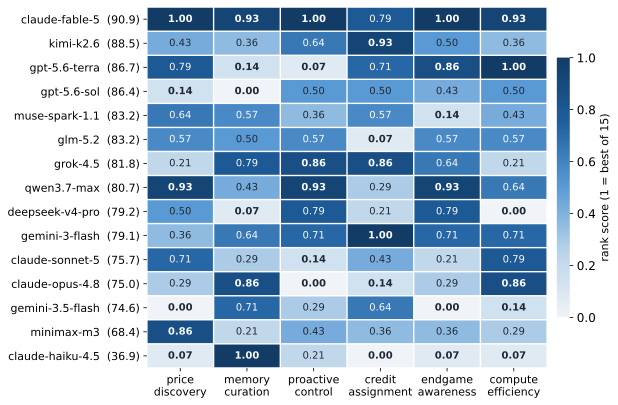
Each column rank-normalizes one behavioral metric across the 15 solo models, averaged over the three seeds (1 = best of 15); rows are sorted by mean final score. The winner is a generalist — no axis below 0.79, mean 0.94, and only three of the six axes led outright. The mid-table pairs a genuine strength with a decisive gap, and the bottom of the board is weak on most axes at once.
| Model capability | Behavioral measurement | rs vs final score |
|---|---|---|
| Endgame awarenessconditioning policy on how much horizon is left | long-horizon actions per season, years 17–20 minus years 2–16 | −0.58 −0.31 / −0.34 / −0.28 |
| Credit assignmentconnecting a cost now to a payoff seasons later | season-end cash ÷ net worth (mean over seasons 2–20) | −0.50 −0.74 / −0.60 / −0.34 |
| Proactive controlacting ahead of foreseeable events instead of on the deadline | contract months remaining when a renewal episode opens (median) | +0.45 +0.68 / +0.18 / +0.47 |
| Price discoverylearning where an unseen acceptance boundary lies | transfer offers per completed signing (oracle reference: 1.0) | descriptive field median 30 |
| Memory curationusing your own writing to outlive the context window | TF–IDF similarity between consecutive season-end notebooks | band, not slope best near 0.35 |
| Compute efficiencyspending tokens where they change a decision | tokens per run; the matrix axis scores points per million tokens | −0.19 p=0.50, null |
Spearman rank correlations against mean final score over the 15 models, with the per-seed coefficients in italics — orderings are the signal, and only the three capabilities that keep their sign on every seed are read as correlations. The strongest are all about time: stopping slow-payoff spending when the horizon runs out, not letting money sit idle, and starting early. Token spend correlates with nothing under any accounting. Two further metrics were pre-registered and failed — warning exposure (per-seed ρ +0.45 / +0.07 / −0.78) and youth harvest (−0.52 / −0.18 / +0.04) flip sign between seeds, and tactic reversals was dropped as an axis for the same reason. The anatomy keeps all three in as negative results.
The environment, the agent loop, and how the composite score is built. What the benchmark calls management is four concrete demands the mechanics impose: hidden information (true player ability is never shown to anyone), cumulative consequences (youth and facilities pay off years later, and honors accrue season by season), a counter-adaptive market (a rejected bid raises the hidden ask, so no fixed strategy stays a best response), and multi-objective pressure (the board judges results and financial discipline jointly). The two boards run the same engine and differ only in who else is in the world: Solo is a single-agent evaluation against fixed-policy opponents, Arena a competitive multi-agent setting evaluated by cross-play — distinct model policies in one world, not one agent against copies of itself. The Arena seats 16 clubs; this board ran 15 models and one scripted anchor in a single shared world (seed 7), while the Solo board is the mean of three separate worlds (seeds 1, 1024 and 2026).
One run is 20 in-game years and about 374 decision stops. At a stop the clock freezes and the agent takes as many turns as it likes — each turn a tool call and its result — then calls advance and the world moves on. The system prompt is frozen; because every stop starts a fresh conversation, the agent's own notebook is the only memory that carries.
The agent manages a fictional club in a 16-club league: buying and selling players, negotiating contracts, picking lineups and tactics, investing in facilities and youth, and keeping the board happy. Seasons play out day by day; every player, club, and price is simulated, with no real-world names, so memorized football knowledge does not help.
The game pauses at decision stops: scheduled moments (season opening, transfer windows, mid-season reviews, board meetings) where the agent reads the latest state of the world and acts. Within one stop the agent can take as many turns as it wants: query, read the results, act, act again, until it decides it is done and advances. A 20-year run logs roughly 340–400 stops — 13 scheduled a season plus about six the world raises unsolicited; how many turns each stop takes is the model's own choice, which is why token use varies widely between models.
Between stops the world moves on its own. Matches are played, finances tick, injuries happen, rivals buy players. A bad plan compounds quietly for seasons before the bill arrives, and the board can fire the manager. A fired seat restarts with a fresh board up to three times, each restart discounting its score; the fourth firing ends its run for good.
The world freezes and the engine hands over a packet: league position, cash, wage ratio, board confidence, everything that happened since the last stop, and the agent's own notebook.
The agent takes as many turns as it likes — scout the market, bid, renew a contract, set the lineup, invest, write to its notebook. The per-stop budget is 30 queries and 10 negotiation moves; the turn cap is 40 soft, 60 hard.
It calls advance and the engine plays on alone: matches, wages,
ageing, injuries, rival transfers. Repeat ~374 times, then one composite score.
The agent talks to the game through 26 tools. An exchange from a transfer-window stop looks like this:
Every action of every run is logged, and any run replays exactly from its log, so every number on these boards can be audited action by action. Before publication we replayed every official run from seed and action log alone — 45 solo runs across three seeds plus the 15 Arena seats: every final score reproduced, drift zero. That audit is also what makes the behavioral measurements in the capability anatomy trustworthy — they are mined from the same replays.
One composite score per run, from three components: trophies and league finishes, growth in club net worth over the run, and the value of the squad handed back. The components are log-compressed and summed:
S_raw = 18·ln(1 + max(H,0)/60) +
10·sign(VA)·ln(1 + |VA|/40) + 6·ln(1 + max(M,0)/80)
Score = ρ·max(S_raw, 0) + min(S_raw, 0)
Zero means the club is worth the same when handed back as when taken over. A model that finishes its 20 years keeps its full score (ρ = 1); a seat fired out of the game keeps its negatives and has its positive part discounted by how early it ended. Each firing along the way also multiplies the score by 0.8. The formula has no cap on paper, but in practice the composite tops out around 145: the honors component maxes out at 63.65 (twenty straight titles), and the wealth components are bounded by what the game economy can produce. Score bars on this page are drawn against that 145-point scale.